




29 Oct Wandering the West
Wandering is the word occupying much of David Griffin’s mind on this warm September morning.
“It always appeared to imply that you were wasting time,” he says. “You didn’t have a purpose or some intent, but as I discovered my particular way of finding images, finding things to paint, I discovered that really I’ve been wandering a lot my whole life.”
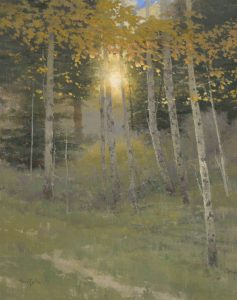
When All Is Right | Oil on Linen on Board | 28 x 22 inches
Griffin has wandered away from his Dallas studio — he has another in Vail, Colorado — and is taking a break from paintings for the 2027 Coors Western Art Exhibit & Sale in Denver, Colorado, to talk about “happy accidents,” also on his mind this morning.
After first wandering into a successful career as an illustrator, Griffin moved to fine art, painting a lot of cowboy images inspired by his working-cowboy grandfather. But roughly 15 years ago, Griffin says, “I took all the cowboys out and just painted dirt and the sky and all the things I had memories of growing up. It became a lot more valuable to me. It kind of became my voice, as a matter of fact.”
Those paintings garnered much attention.
“Growing up on the high plains of the Llano Estacado, David Griffin was exposed daily to a hard land of endless vistas, sprinkled with the occasional misfit elm tree,” says Mark Sublette of Medicine Man Gallery in Tucson, Arizona. It’s Griffin’s deep appreciation for this barren terrain that led him on a lifelong discovery through paint. “His captivating, multilayered, ephemeral landscapes draw the viewer into a painting experience both sacred and lonely. Not in a depressing way, but in a fashion of childlike delight for an unspoiled part of the American West we long to rediscover,” says Sublette.
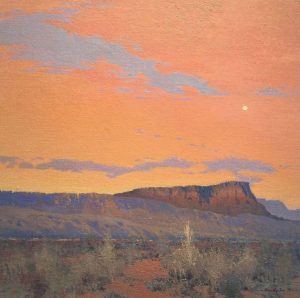
Tasting the Desert Air Gladly | Oil on Linen on Board | 24 x 24 inches
One journalist described Griffin’s work as part memory, part meteorology, and part poetry. There’s no disputing the memory aspect. Much of Griffin’s artwork is based on his childhood near Lubbock in West Texas, where he was born and grew up, which is where his innate curiosity was nurtured. For example, the wonder at how a mesa will look in the early morning as opposed to late in the day, or what happens when the dirt blows or there’s a low cloud in the distance.
And meteorology?
“I’m not a weatherman,” he says, “but I’ve certainly been around a lot of weather in West Texas. If you got out of the city, the horizon was just forever — Lubbock was so flat you could see Friday on Wednesday — and you could watch these storms rolling toward you, and they were getting bigger and louder. You could smell what I became familiar with: the smell of dust or rain.”
And poetry?
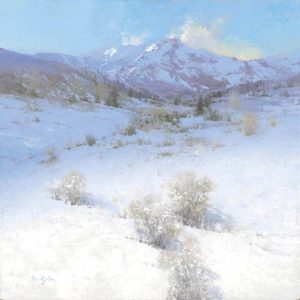
A Conversation without Words | Oil on Linen on Board | 24 x 24 inches
“The poetry part is in the words,” he says. “My paintings’ titles are very important to me. So, I read a lot of poetry, and, of course, the Bible is very important to me. I’ll write words down, make notes of something that I’ve read. I’m pulling visual elements as well as words.”
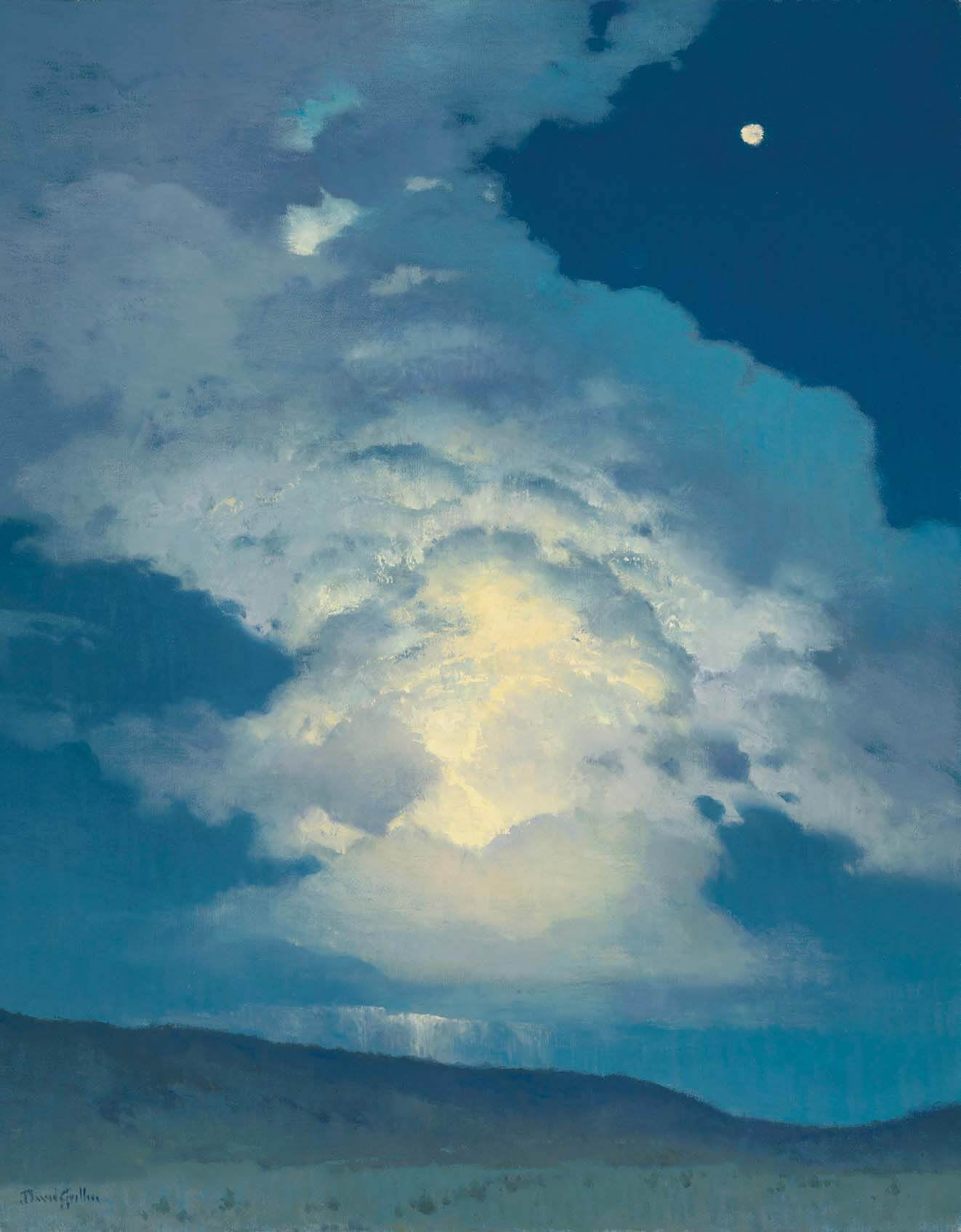
One painting title — Being Still Enough to Listen — comes to mind. Griffin was working on the 36-by-36-inch landscape of a moonlit West Texas scene depicting clouds and sky over mesas and scrub-dotted flats. “In the studio — on location, too, but more in the studio — there’s a conversation going on between me and the painting,” he explains. “It’s not necessarily out-loud words. It may be intuitive thought. I put something down, and it almost responds: ‘Don’t do that,’ ‘That’s the wrong place,’ or ‘Wrong color.’ This particular painting kept telling me: ‘You’re trying to finish this too fast. Slow down. Be still and intentional about your next brushstroke.’ So I thought about that long enough to say, there’s the title: Being Still Enough to Listen.”
Though Griffin takes inspiration from his West Texas memories, he cautions against looking for real places in his works.
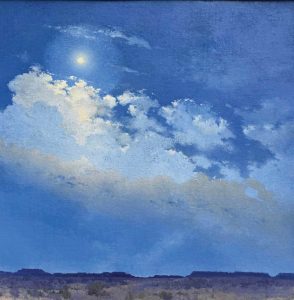
Being Still Enough to Listen | Oil on Linen on Board | 36 x 36 inches
“I take the elements out of three or four places and combine them into one place,” he says. “Maybe there’s one landmark you recognize, but maybe you don’t. People say, ‘Where is this from?’ Well, it’s from outside of Red River, New Mexico, and part of it’s from South Texas in the Big Bend area, and this last one right here is from the desert in Arizona.” Griffin says he has wandered around so much that paintings are like puzzles, fitting pieces together, watching for those happy accidents to come together when he’s working.
One such happy accident made Griffin an artist in the first place. He was studying premed. “I had no business being in that,” he says of his major at Texas Tech University during the Vietnam War. He flunked calculus and chemistry.
“I had about a day or two to reschedule classes because I was right in the middle of the Vietnam draft,” he recalls. “I’d already been through the draft once and was close enough that it got my attention and I really needed to stay in school.”
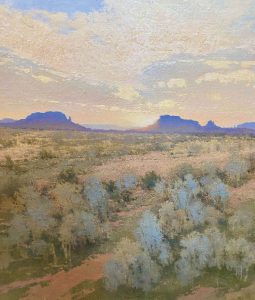
The Art of Wandering | Oil on Linen on Board | 36 x 36 inches
He switched his major to graphic design and was excited by his design and color theory classes. By his senior year, Griffin’s work had impressed one of his professors enough that he sent samples to Illustrators Workshop New York. Griffin was accepted.
There, one of his instructors, Bernie Fuchs — the youngest illustrator elected into the Society of Illustrators Hall of Fame — introduced Griffin to the theory of happy accidents.
“There are things that are going to happen with the brush and the paint that you didn’t anticipate,” Griffin says. “You may have thought, ‘That was an accident, I’ll just wipe it off.’ But if you recognize that there’s something there, it becomes a happy accident, a complete wandering of the brush, if you will, something that you would hold on to and work around, building it instead of trying to erase it.”
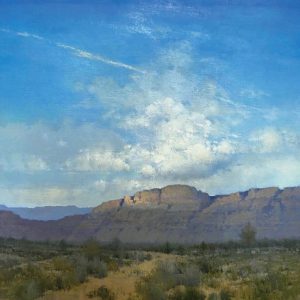
Approaching Reverence | Oil on Linen on Board | 36 x 36 inches
Griffin’s career as an illustrator brought him success, but he got tired of being “a pair of hands,” and so tried painting landscapes. He had a family to support and recalls an intense introduction to the form. “I was drinking from a firehose basically because I didn’t have a lot of time to learn.”
These days, Griffin is well established and thinking of trying paintings as large as 48 by 72 inches.
“I don’t want to go any bigger than that because I don’t think I can do something bigger than that. I want to see if I can transfer these ideas I have in my head from 2-by-3-inch and make a big statement,” he says. “Maybe I’ll wander off into that.”
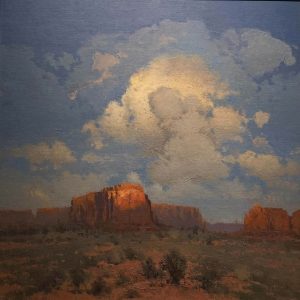
Acquainted with the Language of Clouds | Oil on Linen on Board | 24 x 24 inches
It’s a good place to be. As Sublette says: “Viewing a Griffin landscape is to understand a painter’s perception of light, color, and atmosphere. It’s the ability to live in the moment of another’s mind.”
After all, wandering does not mean wasting time.
“I’ve found it a pretty good use of time,” Griffin says. “I never had an intentional purpose other than curiosity, and seeing what would stop me — just let my mind wander in addition to my feet wandering. Whether I intended that or not, that’s where I am.”
No Comments